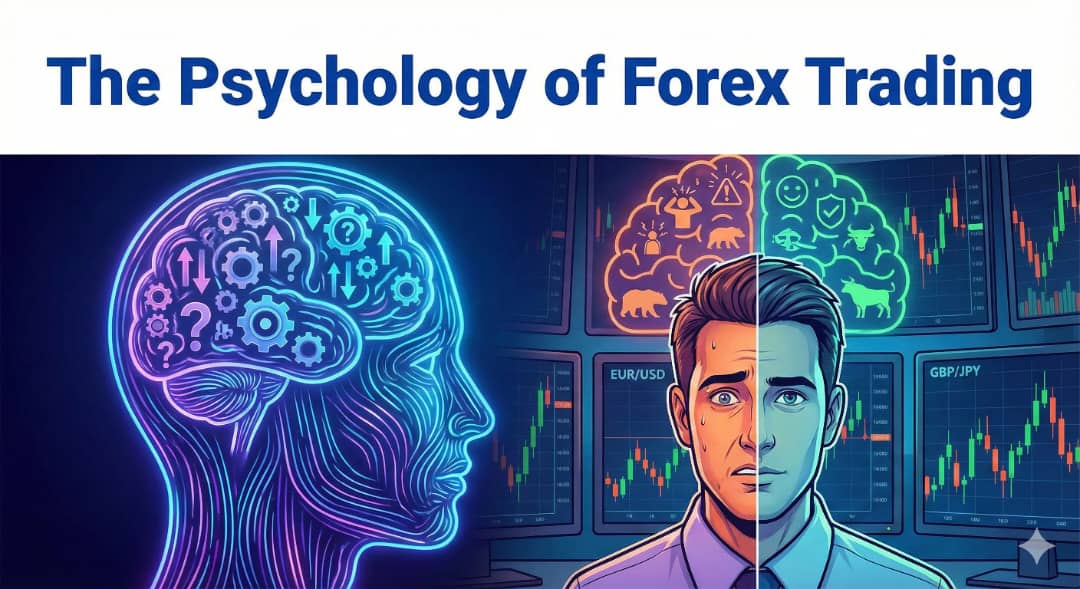

There’s something about Forex that humbles even the most confident person. You’ll enter into it with swag, pick your currency pair like a boss, adjust your lot size with that sharp trader energy, and the moment you click “Buy” or “Sell,” your heart will suddenly start beating fast.
I remember one day, years ago, I sat in front of my laptop in a small café. I told myself, “Today, I will flip this account.” Don’t laugh, every trader has said that thing before. I saw one clean setup on GBP/JPY. The thing was looking like money. Every candle was telling me, “Enter the trade, don’t be scared.” My analysis made sense. My confidence was high. Everything aligned, but guess what didn’t align? My emotions.
The moment I entered the trade, the market moved a little against me. Just a tiny pullback, a normal one. The harmless one that experienced traders ignore. But did I ignore it? No, my mind immediately started creating stories. “What if this thing crashes? What if my stop-loss hits? What if I lose this money? What if I never recover?”
Before I knew it, I closed the trade with a small loss, only for the market to shoot straight in the direction I predicted. That thing pained me more than heartbreak. That day taught me something: Forex is not really a market for candles and indicators. It’s a market for the mind.
People think trading is just charts and strategies. But anyone who has traded for more than two weeks knows that the real enemy is inside your head. Your strategy can be perfect, but your emotions can scatter everything.
So let’s talk about the psychology of Forex trading in a way that actually makes sense. Not textbook grammar, not fake “guru” talk. Just real-life emotions that every trader battles with.
The Fear – The Demon That Whispers “Close It Now”
Fear is the number one emotion in Forex. Even the big traders experience it. Fear of losing. Fear of missing out. Fear of being wrong. Fear of blowing the account.
Fear can make a grown man behave like a child. You’ll be in a winning trade, and instead of letting it run, your fear will start talking: “It might reverse … you better secure this small profit.” Next thing, you close it for $5 profit and the market continues running like Usain Bolt.
Fear makes you trade a little when you should trade confidently. Fear makes you overthink on simple decisions. Fear makes you jump out of trades too early. Fear makes you avoid trades you should take.
But the funny thing? Fear is not the enemy. Your reaction to fear is. Fear is simply your mind trying to protect you from pain. But in Forex, avoiding pain equals avoiding profit. You can’t remove fear, you can only learn to act despite it.
Greed
Greed is the same emotion that has pushed many people into questionable investments. It is loud, confident, and deceptive.
Greed is what makes a trader who planned for a $20 profit suddenly decide he wants $200 in the same trade. It’s what makes you refuse to close a good profit because “the next candle might still go up.”
Greed will whisper, “Just increase the lot size small.” You increase it. Then the market slaps you with a heavy pullback and wipes half your account.
Many traders don’t know that greed and fear are twins. Fear makes you close too early; greed makes you refuse to close at all. One wants to prevent loss, the other wants unlimited gain. Both will destroy you if you don’t control them. Successful traders are not people without greed. They are people who have learned to tame it.
Anger
If you’re a trader and you’ve never taken a revenge on a trade, maybe you’ve never truly traded. Anger is what happens when:
- You hit stop-loss three times.
- You misread a setup.
- You get a wicked whipsaw.
- Your broker’s spread widens at the worst moment.
- Your internet misbehaves when you need it most.
That anger will tell you, “Enter the trade again! Recover it!” It’s the same voice that tells gamblers to bet one more time. And if you obey it, the market might turn against you immediately.
Anger turns traders into reckless soldiers. It makes you forget risk management. It makes you throw away your plan. It makes you increase lot size aggressively. It puts you in a fight with the market, a fight you will lose.
The market is not your enemy. You are your enemy during anger. The only way to beat anger is to log out when it starts. Even if the market is presenting the sweetest setup of your life, if you’re angry, don’t touch it because your judgment is gone, your discipline is gone and your clarity is gone.
Hope
Hope is the reason some people have accounts floating at –$900 equity, praying for “one more reversal.” Hope is the reason some traders remove stop-loss. Hope is the reason you’ll see a downtrend but still believe, “It will come back.”
Hope is a beautiful emotion in life, but in Forex, it can destroy your finances. A losing trade is not a sick patient you should nurse back to health. If your plan says close it, don't hesitate to close it, don’t wait, don’t beg and on’t fantasize. The market doesn’t care about your dreams. So you have to exclude hope and employ discipline.
The Overconfidence That Comes After One Win
You take a clean trade. It hits TP. Maybe even hit TP2. Suddenly you start feeling like the market respects you. You adjust your shoulders a little. You start thinking, “I’ve mastered this thing.”
That small confidence turns into pride. Pride turns into ignoring your plan. Next thing, you start taking trades that don’t match your strategy because “I can see the direction.” Then the market starts to go against you. A single win is not a trophy. It’s just one moment. Don’t let it get into your head.
The Discipline Problem
Everybody can follow a strategy on a calm day. The real test is whether you can follow it on a chaotic day. Discipline is the hardest part of Forex. Not indicators, not the entries and not even the chart patterns.
- Can you stick to your rules after three losses?
- Can you keep your lot size constant even when you’re tempted?
- Can you walk away when the market is messing with your mind?
- Can you wait for a setup that takes four hours to form?
- Can you take a break after a huge win?
Most traders can’t and that’s why psychology destroys more accounts than bad analysis.
Why Your Mind Behaves This Way (The Real Science Behind It)
Humans are wired for survival. The brain hates uncertainty. It hates risk. It hates waiting. It hates discomfort. Forex trading forces you into all the things your brain tries to avoid:
- Uncertainty
- Risk
- Patience
- Delayed gratification
- Losses
- Discipline
- Self-control
- Emotional neutrality
Your brain didn’t evolve for this kind of environment. So when you’re trading, the battle is really between your ancestral survival instincts and modern financial demands.
- Your brain wants security, but forex offers uncertainty.
- Your brain wants immediate reward, but forex requires delayed reward.
- Your brain loves patterns, even when they don’t exist, but forex moves in unpredictable waves.
That clash creates emotional turbulence, the turbulence creates mistakes and the mistakes create losses. Understanding this is the beginning of emotional mastery.
How to Master Your Trading Emotions
Let’s talk about real solutions. Let’s talk about what actually works.
Mastery Tip 1: Trade a little Until Your Mind Is Stable
- Big lot sizes trigger fear.
- Small lot sizes create calm.
When your money isn’t under serious threat, you think clearly. Clear thinking leads to better decisions. You can scale up later, but master your emotions first.
Mastery Tip 2: Use a Trading Plan Like a Constitution
Your plan is not a casual suggestion, it's the law. Your entries, exits, SL, TP, risk per trade, market conditions, everything must be written. Traders without a plan always fall back on emotions. A written plan removes guesswork.
Mastery Tip 3: Accept Losses as Part of the Business
Losses are not punishments. They are operating expenses. Once you accept this, you stop reacting emotionally. Every business has a cost. So, Forex is not different. Some days you profit, some days you lose. What matters is consistency.
Mastery Tip 4: Stop Watching Trades Every Second
Monitoring candles is emotional torture. Watching price fluctuate will make you do nonsense. Enter the trade based on logic, not emotion and walk away when necessary. If your stop-loss and take-profit are in place, you don’t need to babysit anything.
Mastery Tip 5: Take Breaks After Big Losses or Big Wins
Both situations can distort our judgment. After a loss, you want revenge. After a win, you want to overtrade. In that situation, you need to walk away, reset your mind and return fresh.
Mastery Tip 6: Journal Every Trade
You should write down:
- Why you entered
- How you felt
- What went wrong
- What went right
This builds self-awareness, and self-awareness fixes emotional patterns faster than anything else.
The Secret Nobody Tells You
Most traders don’t fail because they lack knowledge. They fail because they lack control.
- Control of emotions.
- Control of impulses.
- Control of expectations.
- Control of fear.
- Control of greed.
Trading is like driving on a very busy bridge . You know the road, but if you panic, you’ll crash. If you’re too confident, you’ll crash. If you’re distracted, you’ll crash.
- Your emotions are the steering wheel.
- Your strategy is the engine.
- Your risk management is the brakes.
If any one of them fails, the journey becomes dangerous.
The Trader You Must Become
To win in Forex long-term, you must become a different kind of person. Someone calm under pressure. Someone patient when others are rushing. Someone rational when others are emotional.
You need to become:
- The trader who can miss a setup and not chase.
- The trader who can hold a winning trade without shaking.
- The trader who can cut a losing trade without sentiment.
- The trader who can walk away from the screen.
- The trader who can accept a bad day without losing their mind.
Forex rewards emotional maturity more than intelligence.
A Personal Story to Show You Why Psychology Matters More Than Strategy
A friend of mine knew Forex better than anyone I had ever met. This guy could analyze charts like he created the market himself. He understood liquidity, structure, order blocks, everything. In fact, he was the person people ran to for mentorship. But he had one problem: his emotions.
Whenever he lost two trades back-to-back, he would lose control. His hand would start shaking slightly. He would open bigger positions. He would convince himself that recovery is just one trade away. And within one week, he could destroy everything he had built for three months.
One day, he blew a $10k account. Not because of knowledge, he had enough. Not because of bad strategy, his strategy was sharp. But because of emotional impulse.
Meanwhile, I’ve met traders who don’t even analyze charts deeply. They trade simple setups, obey simple rules, and grow consistently. Not because they know more, but because they don't allow their emotions to control them. Forex is not a market for emotional people. It is a market that rewards emotional discipline.
Final Thoughts
At the end of the day, the chart is not your biggest problem. The broker is not your biggest problem. The market makers are not your biggest problem, your mind is.
- If you master your mind, you master the market.
- If you master your emotions, you master your results.
And once you get to that point where:
- Losses no longer shake you
- Wins no longer excite you too much
- Setups don’t control you
- Fear doesn’t weaken you
- Greed doesn’t drive you
- Hope doesn’t blind you
- Anger doesn’t mislead you
…you become a different kind of trader entirely.
- A trader who survives.
- A trader who grows.
- A trader who lasts.
- A trader who wins over time.
Because the market doesn’t reward the strongest or the smartest, it rewards the calmest.