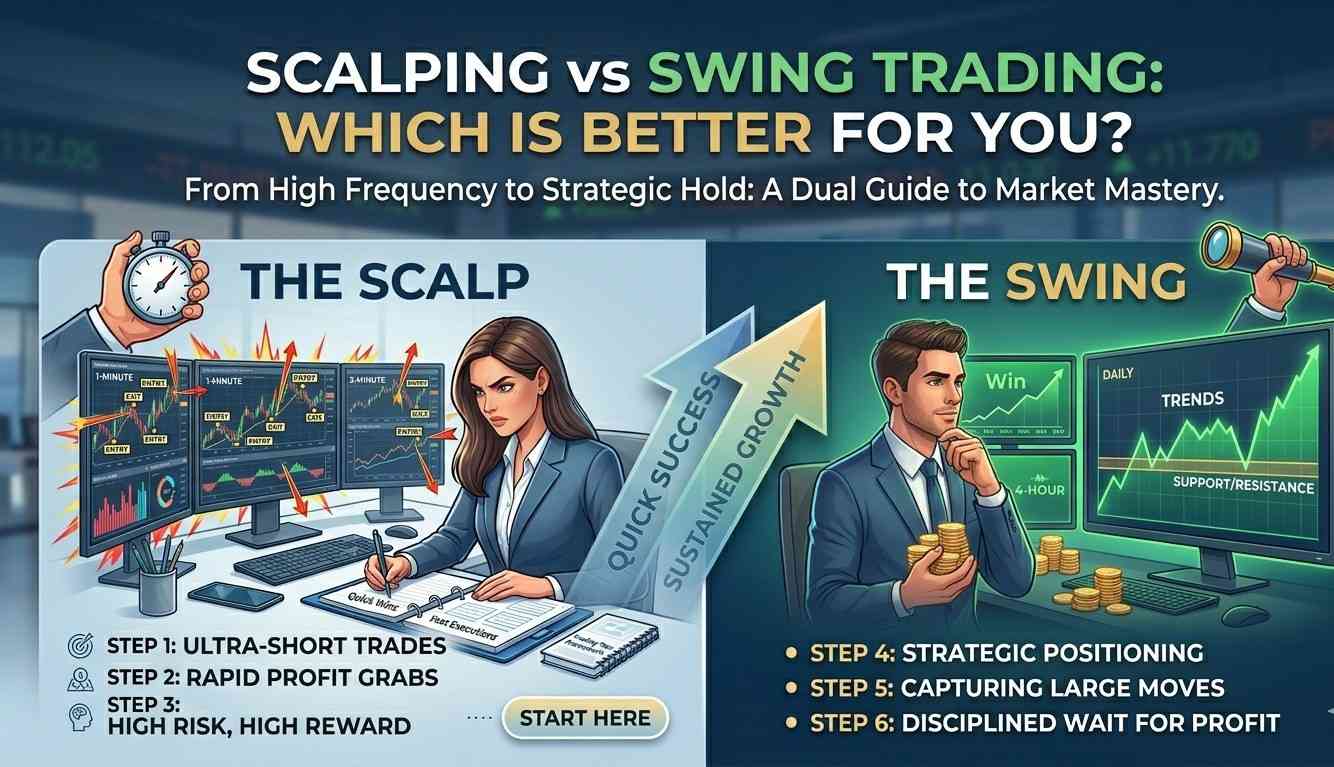

Let me say something that might annoy a few traders. Most people arguing “scalping vs swing trading” don’t even know themselves well enough to make that choice. They just follow vibes. One guy sees fast profits on TikTok, suddenly he’s a scalper. Another sees someone holding trades for days and flexing big wins, boom, he’s now a swing trader. No self-awareness. No structure. Just vibes and screenshots. But trading doesn’t reward vibes. It rewards alignment between your personality, your time, your discipline, and your emotional strength. So instead of asking which one is better, the real question is:
Which one is better for YOU?
Let’s gist properly.
The Fast Lane: Scalping
Scalping is not trading. Let’s call it what it is. It’s war. You are entering the market, grabbing small profits, sometimes just a few pips and exiting quickly in minutes and sometimes seconds. You blink, opportunity has passed. This is the kind of trading where your heart can be doing racing like generator that needs servicing. You need speed, precision and focus.
You’re watching charts like your life depends on it. Because honestly, your account balance does. I remember one time I tried scalping seriously. I sat down, opened my charts, told myself, “today, I'm going to make money sharp sharp.” Two hours later, I was mentally exhausted and my account was somehow smaller. That’s scalping for you.
It looks easy from the outside. But inside? It's a pressure cooker.
Why Some People Love Scalping
Let’s be honest, there’s something addictive about quick wins. You enter, you exit, you collect profit. No long waiting, no overnight stress, no waking up to surprise losses because of news. It feels like control. And if you’re the kind of person that hates waiting, like you can’t even watch a Netflix show without checking your phone scalping will feel natural to you.
Also, you don’t need to worry too much about big market trends. You’re just riding small movements. But here’s the catch nobody tells you loudly enough:
Scalping punishes emotional weakness immediately.
One mistake, one hesitation and one greedy move. Your profits will vanish into the thin air
The Hidden Cost of Scalping
People talk about profits, but they don’t talk about the lifestyle. Scalping demands your time. Your full attention. You can’t be in a meeting and also be scalping. You can’t be driving and scalping (please don’t even try). You can’t just be distracted. It’s a full-time mental job and then there’s fees. The Spread, Commission and Slippage.
All those little costs? They add up. So even if you win often, you need to win very consistently to stay ahead. That’s why many beginners burn out quickly. Not because they’re stupid but because scalping is mentally expensive.
Now Let’s Talk Swing Trading
Swing trading is the opposite energy. This one is calm, calculated and needs patience. Instead of chasing small moves, you’re capturing bigger market swings over days or even weeks. You’re not rushing, you’re not reacting to every small candle. You’re thinking bigger. It’s like fishing with a net instead of a hook. You analyze, plan and enter the trade, then you wait. And that “wait” is where most people fail.
The Patience Game
Let me be honest with you, waiting is harder than clicking buy or sell. You enter a trade, you set your stop loss and take profit, then you sit there watching the price move slowly. Sometimes it goes in your favor. Sometimes it goes against you before coming back. Your mind will start whispering:
“Close it now before it reverses.” “Take small profit, don’t be greedy.” “What if it crashes?” That inner voice is dangerous. Swing trading tests your discipline more than your skill because the strategy is often simple. The real challenge is not interfering with your own plan.
Why Swing Trading Feels More “Adult”
There’s a maturity to swing trading. You’re not chasing every opportunity, you’re waiting for high-probability setups. You’re not glued to your screen because you have a life outside charts. You can have a 9–5 job, run a business, or even sleep peacefully. So, your trades don’t control your day and for people in countries, where time is structured, schedules are tight, and distractions are many, this matters a lot. You can check your trades in the morning, maybe once in the evening, and you’re good. No stress, no overtrading.
But Swing Trading Isn’t Perfect Either
Let’s not pretend, holding trades overnight comes with risk. News events, market gaps and unexpected volatility can hit you. You might go to bed in profit and wake up to confusion. Also, you won’t get that constant “dopamine hit” that scalpers enjoy. Some days, nothing happens. Where you don't trade at all, just waiting. And for many people, that’s boring, but sometimes, boring is profitable.
Personality Check: Who Are You Really?
Forget strategies for a second. Let’s talk about YOU because this is where most traders get it wrong.
If you’re someone who:
- Gets anxious easily
- Checks your phone every 2 minutes
- Hates waiting
- Enjoys fast decisions
Scalping might feel natural, but it can also destroy you emotionally if you’re not disciplined.
Now, if you’re someone who:
- Thinks long-term
- Is patient (or trying to be)
- Doesn’t like constant pressure
- Has a busy daily schedule
Swing trading might be your lane, but here’s the twist nobody likes to hear:
Your natural tendency is not always your best option.
Some impatient people actually become better swing traders because it forces them to grow and some calm people fail at swing trading because they become too passive. So it’s not just about comfort. It’s about growth.
The Money Conversation
Let’s talk about results, because at the end of the day, that’s why we’re here. Scalping can give you frequent profits, but small profits. You’re stacking gains and the volume matters a lot.
Swing trading? You take fewer trades, bigger targets. One good trade can outperform ten scalping trades. But consistency is key in both.
A bad scalper loses fast.
A bad swing trader loses slowly.
Pick yours
Time: The Most Underrated Factor
This one is so important. Scalping demands hours of screen time. Swing trading gives you flexibility.
So ask yourself:
Do I really have the time to sit and watch charts daily? Or am I forcing a lifestyle that doesn’t fit me? Because if your strategy doesn’t match your life, you’ll eventually quit and the market doesn’t care about your intentions.
The Emotional Reality Nobody Posts Online
Let me tell you something real. Trading is less about strategy and more about emotional control. So, scalping will expose your impatience. Swing trading will expose your fear. In fact, both will test your discipline. That’s why copying someone else’s style rarely works long-term because you’re not them. You don’t think like them and you don’t react like them.
So… Which One Is Better?
Let’s not dodge it. If you want speed, action, and you can handle pressure, scalping can work. If you want flexibility, less stress, and you’re willing to be patient, swing trading is powerful.
But the real answer?
The better strategy is the one you can stay consistent with. Not for one week, not for one lucky trade, but over the months.
A Smarter Approach (That Most People Ignore)
You don’t actually have to choose only one. Some traders scalp during active sessions and swing trade on higher timeframes. It’s like having two income streams. But be careful because if you’re still learning, mixing strategies can confuse you. So, it's better to master one first, then expand later.
Final Thought
Trading is not about finding the “best” strategy, it's about finding the strategy that fits your mind, your schedule, and your discipline level. Scalping will test your speed. Swing trading will test your patience.
Either way, the market will test YOU. So before you pick a side, take a step back and ask yourself honestly:
Am I choosing this because it fits me… or because it looks exciting?
Because in trading, excitement is expensive. Consistency is what pays.